Whales off the coast of Iceland
Iceland sits where cold and warmer North Atlantic currents meet, creating productive feeding grounds for whales, dolphins and porpoises. Twenty-three cetacean species have been recorded in Icelandic waters and around a dozen are seen regularly. This guide explains the species you may encounter, the best seasons and places, and which whale-watching trips fit each region.
Quick guide to whales in Iceland
| Regular sightings | Humpback whales, common minke whales, white-beaked dolphins and harbour porpoises |
|---|---|
| Main season | April to September; selected tours also operate in winter |
| Best-known bases | Húsavík, Reykjavík, Akureyri, Hauganes, Dalvík, Ólafsvík, Ísafjörður and Hólmavík |
| Typical trip | About 2–3 hours, depending on the harbour, vessel and conditions |
| Good to know | Every sighting is wild and weather-dependent; dress for a colder, windier day at sea |
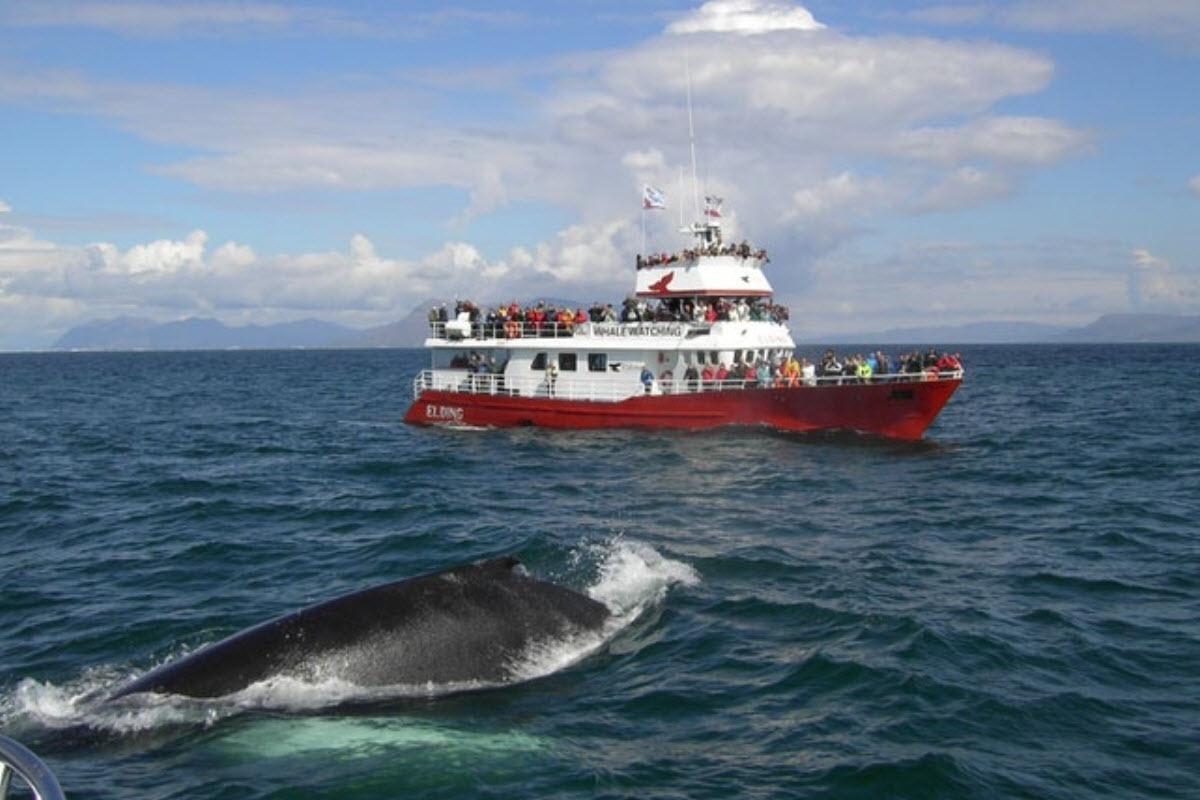
Whale watching in Iceland
Whale watching is possible from several harbours, but each region offers a different setting. Húsavík opens directly onto Skjálfandi Bay, Reykjavík gives easy access to Faxaflói Bay, and the long waters of Eyjafjörður can be comparatively sheltered. Farther west, Ólafsvík is especially interesting for seasonal orca sightings, while Ísafjarðardjúp and Steingrímsfjörður offer small-scale Westfjords departures.
The broadest choice of departures is normally available from late spring through summer. April to September is the main viewing period because the productive coastal waters attract feeding animals and many operators run several trips a day. Reykjavík and Akureyri also have selected year-round departures. Winter can bring dramatic light and quiet boats, but schedules are thinner and weather cancellations are more likely.
No operator can guarantee a particular species or behaviour. The animals move with prey, tides and sea conditions, so a patient, naturalist-led trip is more rewarding than treating a close encounter as promised. Large traditional boats usually offer more shelter and room to move; RIBs are faster and carry smaller groups but feel colder and are less suitable for some travellers.
How to choose the right whale-watching region
Reykjavík and Faxaflói Bay
Reykjavík is the most convenient choice for a short city stay. Boats leave the Old Harbour and search the broad waters of Faxaflói Bay, with Esja, Snæfellsjökull and the Reykjanes coastline forming the horizon. Common minke whales, humpback whales, white-beaked dolphins and harbour porpoises are among the regular possibilities, while seabirds add interest in summer.
Choose a classic larger boat for comfort and indoor space, a RIB for a faster small-group experience, or a combined wildlife and museum trip if you want more context. Summer evening departures use the long daylight, while standard daytime trips are the most flexible option year-round.
Húsavík and Skjálfandi Bay
Húsavík is Iceland's best-known whale-watching town. Its harbour faces Skjálfandi Bay, a deep, mountain-framed feeding area with access to varied habitats. Humpback and common minke whales are frequent highlights, white-beaked dolphins may appear, and blue whales are an exceptional seasonal possibility rather than an expectation.
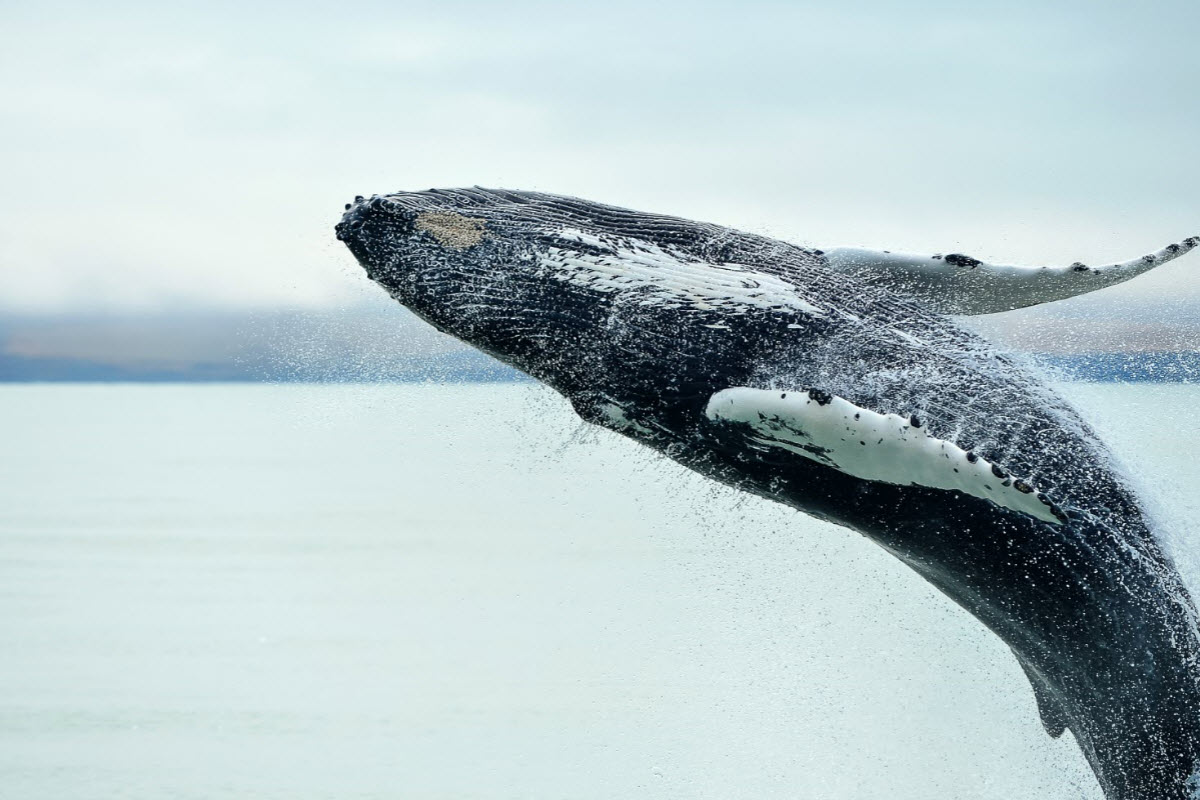
Húsavík has both traditional wooden boats and quicker RIBs. Classic trips suit families and travellers who value deck space; RIB safaris cover more water and often combine whale searching with puffin areas during the nesting season. A museum visit in town adds useful biological and research context.
Akureyri, Hauganes, Dalvík and Eyjafjörður
Eyjafjörður is a long northern fjord with several departure points. Akureyri is easiest for travellers staying in town or arriving by cruise ship. Hauganes and Árskógssandur shorten the distance to the outer fjord, while Dalvík sits beneath the high Tröllaskagi mountains. Humpback whales are a major draw, with common minke whales, harbour porpoises and dolphins also possible.
Because the fjord is narrow and mountain-sheltered, trips here can feel calmer than open-ocean routes, although Icelandic weather still changes quickly. Pick the harbour that fits your road trip rather than driving past one good departure for another. RIB and larger-boat formats are both available.
West Iceland and the Westfjords
Ólafsvík on the Snæfellsnes peninsula is Iceland's most distinctive seasonal option for travellers hoping to see orcas. Sightings depend strongly on prey movements and the time of year, and sperm whales, pilot whales, humpbacks and white-beaked dolphins are also possible. The route into Breiðafjörður adds views of Snæfellsjökull and the peninsula's volcanic coast.
The Westfjords offer quieter departures from Ísafjörður into Ísafjarðardjúp and from Hólmavík into Steingrímsfjörður. These trips suit a multi-day regional itinerary and should be booked around local schedules rather than treated as a quick detour. There are fewer bookable departures than in Reykjavík or North Iceland, which is why this carousel contains the three current region-specific options.
East and South Iceland
Cetaceans occur around the entire coast, including deeper waters off East and South Iceland, but regular visitor departures are concentrated in the west and north. If whale watching is a priority, plan a dedicated trip from one of the established harbours above instead of relying on an incidental sighting from shore. Coastal viewpoints may still produce distant blows or dolphins, especially in calm weather, but binoculars and patience are essential.
Whales, dolphins and porpoises in Icelandic waters
Cetaceans are mammals: they breathe air, are warm-blooded, give birth to live young and nurse their calves. They divide into two main groups. Baleen whales filter small schooling fish, krill and other prey through plates of baleen. Toothed whales, dolphins and porpoises use teeth to catch fish, squid or other marine animals, and many use sophisticated echolocation.
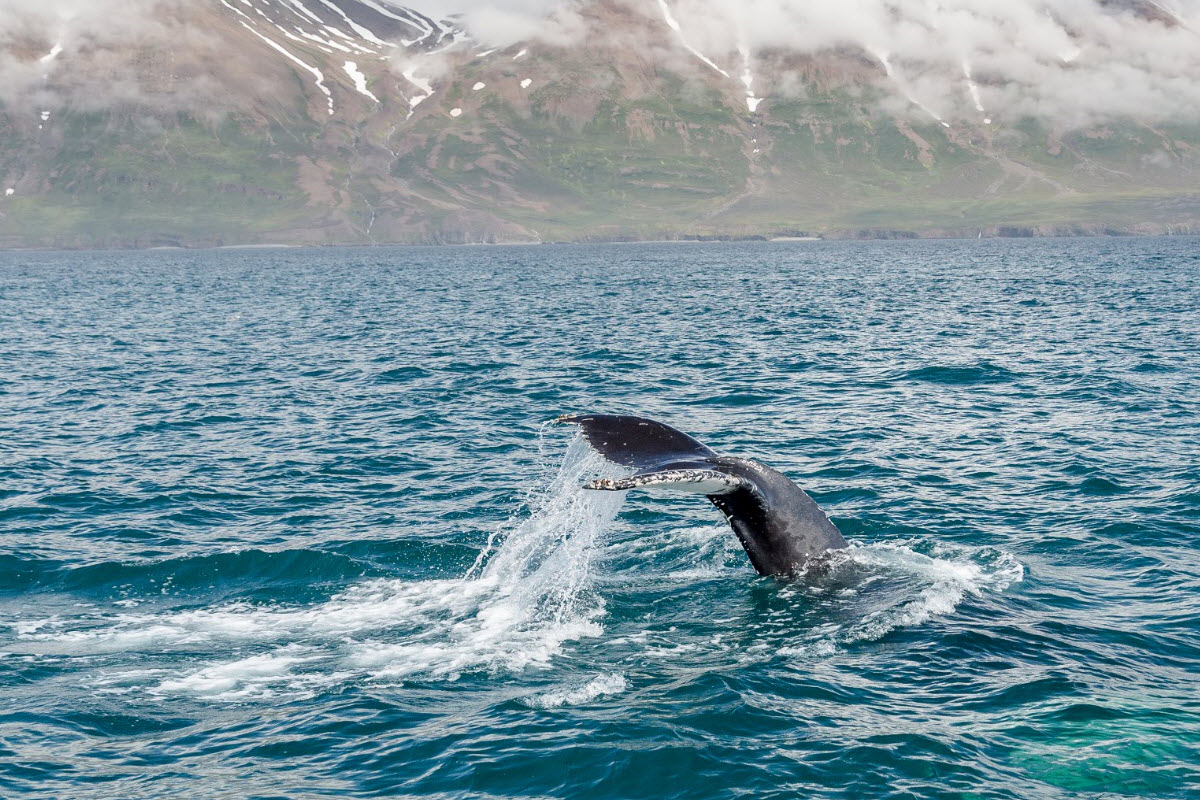
The species below retain and correct the original guide's list, then add other regularly recorded Icelandic cetaceans. Size ranges are approximate because males and females can differ and exceptional individuals fall outside typical values.
Humpback whale (Megaptera novaeangliae)
Humpbacks are among Iceland's most recognisable whales. Long white-edged pectoral fins, a knobbled head and a strongly arched back help with identification. Adults are commonly around 12–16 metres long. They often feed on capelin, herring and krill and may show flukes, lunge-feed, slap the surface or occasionally breach. Skjálfandi Bay and Eyjafjörður are especially well known for summer humpback sightings.
Common minke whale (Balaenoptera acutorostrata)
The common minke is the smallest baleen whale regularly seen around Iceland, typically about 7–10 metres long. It has a pointed head, a curved dorsal fin and a distinct white band on each flipper. Minkes can surface quietly and disappear quickly, so guides often identify them from the sequence and direction of their breaths. They occur around the continental shelf and may be seen from Reykjavík, Húsavík and other coastal harbours.
Fin whale (Balaenoptera physalus)
Fin whales are long, streamlined baleen whales that can exceed 20 metres. Their unusual lower-jaw colouring—dark on the left and pale on the right—is a useful identification feature at close range. They are powerful, fast swimmers and are more often encountered in deeper offshore water than on a short harbour cruise, though sightings do occur around Iceland.
Blue whale (Balaenoptera musculus)
The blue whale is the largest animal known to have lived, reaching roughly 24–30 metres. Its broad mottled blue-grey back can seem to roll across the surface before the small dorsal fin appears. Blue whales feed mainly on krill. They are rare on any single trip, but Skjálfandi Bay is one of Iceland's best-known seasonal areas for a chance encounter in late spring and early summer.
Sei whale (Balaenoptera borealis)
Sei whales are sleek baleen whales of deeper water, usually around 12–16 metres. They have a tall, strongly curved dorsal fin and generally do not arch or raise the tail flukes as dramatically as humpbacks. They occur seasonally in Icelandic waters but are not a routine coastal-tour sighting.
Orca or killer whale (Orcinus orca)
Orcas are the largest members of the dolphin family. Their black-and-white pattern, tall dorsal fin and close social groups are unmistakable. Icelandic orcas often follow schooling fish, so distribution changes with prey. The waters around Snæfellsnes, particularly departures from Ólafsvík, offer the country's most regular seasonal opportunity, but sightings remain unpredictable.
White-beaked dolphin (Lagenorhynchus albirostris)
The original page called this a whale and combined it with another species. It is correctly a North Atlantic dolphin with the single scientific name Lagenorhynchus albirostris. Adults are usually about 2.4–3.1 metres long, with a robust body, tall dorsal fin and pale markings around the beak and flanks. Groups can be energetic around boats and are seen in both northern and western tour areas.
Atlantic white-sided dolphin (Leucopleurus acutus)
This offshore dolphin has a dark back and a distinctive pale and yellowish flank pattern. It often travels in groups and favours cool North Atlantic waters. It is recorded around Iceland but is generally encountered less often on standard coastal trips than the white-beaked dolphin.
Harbour porpoise (Phocoena phocoena)
Harbour porpoises are small, shy cetaceans, usually around 1.4–1.9 metres long. Their low triangular dorsal fin may be the only feature visible during a brief rolling surfacing. They are widespread in coastal water but easy to miss, particularly in choppy seas.
Long-finned pilot whale (Globicephala melas)
Pilot whales are large, highly social dolphins with rounded heads and long, curved flippers. Adults may reach roughly 4–6.5 metres. They favour deeper water and can travel in large, tightly coordinated groups. They are occasional rather than dependable sightings on most visitor cruises.
Sperm whale (Physeter macrocephalus)
Sperm whales are the largest toothed whales, with large males reaching about 16–18 metres and sometimes more. Their block-shaped head and low, angled blow are distinctive. They can make deep, long dives for squid and fish. The animals recorded around Iceland are often males using northern feeding grounds; Snæfellsnes and deeper offshore waters offer occasional sightings.
Northern bottlenose whale (Hyperoodon ampullatus)
This deep-diving beaked whale has a bulbous forehead and pronounced beak. It feeds mainly on squid in deep North Atlantic water and is occasionally recorded off eastern and southeastern Iceland in warmer months. It is included for completeness, but it is not a realistic target on a normal two- or three-hour coastal tour.
Migration, feeding and behaviour
Many baleen whales use Icelandic waters as rich summer feeding grounds. They build energy reserves by following capelin, herring, sand eel and krill, then some populations travel to lower-latitude breeding areas. The pattern is not identical for every species or individual: some humpbacks remain into winter, toothed whales may follow mobile fish schools, and local conditions can shift from year to year.
Blows, dorsal fins, scars and tail flukes allow researchers and guides to identify species and sometimes individuals. Humpback flukes are particularly useful because the shape, pigmentation and markings on the underside form a natural fingerprint. Repeated photographs help reveal movements between Icelandic feeding areas and other parts of the North Atlantic.
Whales communicate with sound. Toothed cetaceans use clicks for echolocation and social communication, while baleen whales produce lower-frequency calls that travel long distances. Humpback song is the best-known example, but most vocal behaviour happens below the surface and cannot be heard from an ordinary sightseeing boat without specialist equipment.
Whale museums and exhibitions
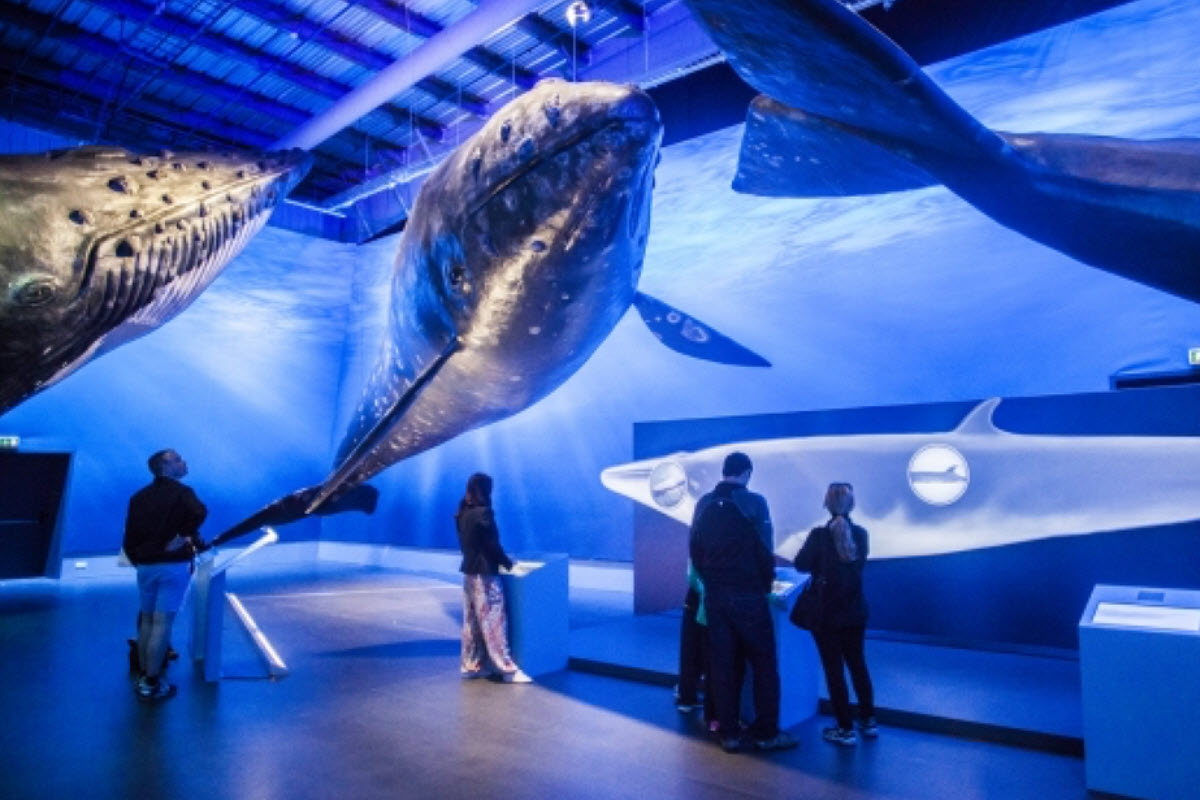
Húsavík Whale Museum is a natural companion to a Skjálfandi Bay trip. Skeletons, research displays and regional interpretation show the scale and biology of the animals seen offshore. In Reykjavík, Whales of Iceland uses full-size models to compare species that are difficult to appreciate from a brief surface sighting. Either visit works well before a boat trip, when identification tips are fresh, or afterwards, when you can connect the exhibits to what you saw.
Planning a comfortable and responsible trip
- Wear warm layers beneath a windproof and waterproof outer layer; the temperature at sea can feel much colder than in town.
- Use gloves, a hat and shoes with a secure, non-slip sole.
- If you are prone to motion sickness, follow professional advice early rather than waiting until the boat is underway.
- Keep camera straps secure and use a moderate zoom instead of leaning over rails.
- Follow the crew's safety instructions and give wildlife space; responsible operators slow down, avoid crowding and let the animals choose the encounter.
- Leave flexibility in your itinerary because wind and sea conditions can move or cancel departures.
Frequently asked questions about whales in Iceland
What is the best month for whale watching in Iceland?
May through August gives the widest choice of departures and generally strong feeding-season opportunities. April and September can also be excellent, while selected Reykjavík and Akureyri trips continue through winter.
Where is the best place to see whales in Iceland?
Húsavík is the best-known base and offers varied trips on Skjálfandi Bay. Reykjavík is the most convenient, Eyjafjörður is useful for Akureyri and North Iceland itineraries, and Ólafsvík is the most distinctive option for seasonal orca possibilities.
Which whale species am I most likely to see?
Humpback whales and common minke whales are regular highlights, with white-beaked dolphins and harbour porpoises also widespread. The mix changes by region and season, and no wild species is guaranteed.
Are whale-watching tours suitable for children?
Many classic larger-boat trips are family-friendly, with railings, indoor areas and flotation overalls. Age, height and health limits are more common on RIB tours, so check the individual product page before booking.
What happens if the weather is poor?
The operator may change the departure time, move the trip or cancel for safety. Keep contact details current, check messages before travelling to the harbour and leave some flexibility for a later departure.