The Sun Voyager (Sólfar)
The Sun Voyager (Sólfar) is Jón Gunnar Árnason’s stainless-steel dream boat on Reykjavík’s waterfront. Open around the clock and free to visit, the sculpture combines art, sea, sky and views of Mount Esja in one of the capital’s most rewarding short walks.
Quick guide to the Sun Voyager
| What it is | A stainless-steel public artwork known in Icelandic as Sólfar |
|---|---|
| Artist | Jón Gunnar Árnason |
| Unveiled | 18 August 1990, during Reykjavík’s bicentenary year |
| Admission | Free; the outdoor site is open at all times |
| Time to allow | 15–30 minutes, or longer as part of a waterfront walk |
| Best light | Sunrise, sunset, blue hour and clear winter days |
| Good to know | It is a dream boat and ode to the sun, not a literal Viking ship |
| Coordinates | 64.1476, -21.9223 |
Why visit the Sun Voyager?
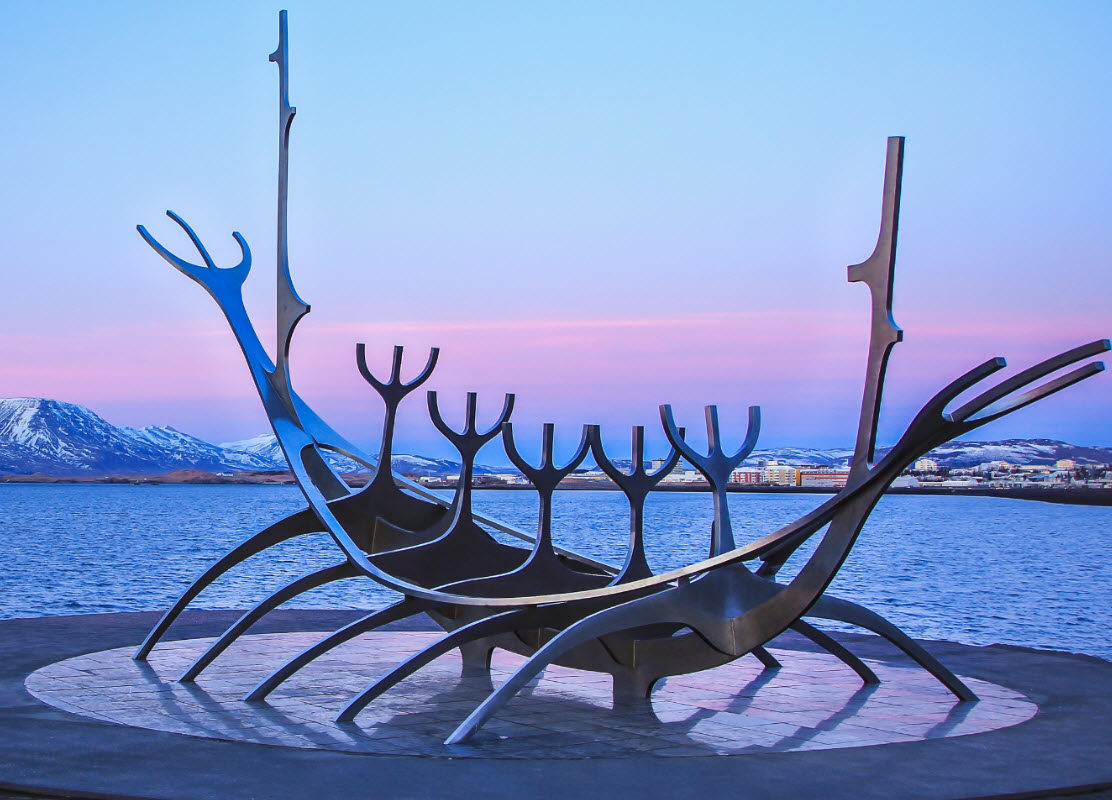
The Sun Voyager is one of Reykjavík’s most photographed landmarks because the sculpture and its setting work as a single composition. Polished steel rises above the seawall while Faxaflói Bay, Mount Esja and a wide northern sky provide a constantly changing background. The stop is free, central and easy to combine with Harpa, the old harbour or a longer walk along Sæbraut.
A quick visit takes only a few minutes, but weather and light reward patience. Reflections move across the steel, low sun throws long shadows over the paving and mist can make Esja disappear completely. The site therefore feels different in bright summer midnight light, autumn rain, winter blue hour and a clear frosty morning.

A dream boat, not a Viking ship
Its ship-like ribs naturally suggest a Viking vessel, especially to travellers arriving in Iceland’s saga country. Jón Gunnar Árnason, however, conceived Sólfar as a dream boat and an ode to the sun. The work is about hope, discovery, freedom and the promise of an unknown destination rather than a reconstruction of a historical craft.
That distinction changes the way the sculpture is read. Instead of looking for archaeological detail, follow the open lines, the forward reach of the bow and the way the sea and horizon appear through the frame. The viewer completes the work by imagining where the vessel might travel.
History and artist
Jón Gunnar Árnason created the design after winning a competition connected with Reykjavík’s 200th anniversary. The full-size stainless-steel sculpture was unveiled on 18 August 1990, Reykjavík’s birthday. Jón Gunnar died before the final installation and the finished work was built under the supervision of his collaborators.
The waterfront location has sometimes prompted debate, yet it has become central to the sculpture’s identity. The open bay gives the dream boat a destination, while Mount Esja supplies a strong landform behind its spare geometry.
Photography and the best light
Sunrise can place colour behind the city side of the sculpture, while evening light often warms the steel and opens the view towards Esja. Blue hour is excellent for balancing detail in the artwork with colour in the sky. In summer, late-evening and near-midnight light can be especially soft; in winter, a low sun produces dramatic contrast even in the middle of the day.
Try three viewpoints: a centred view through the ribs, a low side angle that separates the bow from the horizon, and a wider composition including the seawall and people for scale. The steel can become slippery in rain, ice or sea spray, so stay on the paving rather than climbing on the artwork.
Getting there and the Sæbraut waterfront walk
The Sun Voyager stands on the Sæbraut promenade a short walk east of Harpa Concert Hall. From Harpa, follow the water for roughly ten minutes. The path is level and exposed to wind; dress for conditions even when the centre of Reykjavík feels calm.
Continue east for a longer coastal walk, or turn inland through the city centre towards Hallgrímskirkja. Benches and the broad promenade make the site accessible for most visitors, although winter ice can affect the paving. Parking nearby is limited, so walking or using a city bus is usually simpler.
Reykjavík city tours near the Sun Voyager
These live FunIceland experiences place the waterfront artwork in a wider story of Reykjavík, from settlement history and folklore to food and architecture.
See also in Reykjavík
Continue exploring with three places that fit naturally into a Reykjavík waterfront day.
Frequently asked questions about the Sun Voyager
No. Its form recalls a ship, but Jón Gunnar Árnason described it as a dream boat and an ode to the sun rather than a historical Viking vessel.
Yes. It is an outdoor public artwork with no admission charge and can be visited at any time.
It stands on the Sæbraut waterfront in central Reykjavík, about a ten-minute walk east of Harpa Concert Hall.
Icelandic sculptor Jón Gunnar Árnason created the work from his competition-winning design.
It was unveiled on 18 August 1990 during celebrations marking Reykjavík’s 200th anniversary.
Allow 15–30 minutes for the sculpture and photographs, or include it in a longer walk between Harpa and the eastern waterfront.
Sunrise, sunset and blue hour offer the richest light. Clear days reveal Mount Esja, while mist and winter weather can create equally strong atmospheric images.
No. Stay on the surrounding paving to protect the artwork and avoid slipping on wet or icy steel.
The level waterfront promenade is generally accessible, but it is exposed to wind and can become icy in winter.
Harpa is the closest major landmark. The old harbour, Hallgrímskirkja and Höfði House also combine well with the waterfront walk.